Monday, June 1, 2015

Why did we fare so well this spring? Science, Maintenance practices or luck?

Long story.... so if you have some time, here is the condensed version:


I've been asked numerous times about why our course came through the winter quite well while many courses on our Island had severe damage.  Was it Science? Was it our preventative planning? Was it luck?   Well, it's always good to be lucky, but in this case it was all because of what we did and have been doing for years that helped us get through the devastating winter weather relatively unscathed.

About 15 years ago, I suggested to that we aggressively try to reduce our Poa Annua (annual bluegrass) populations.  At the time, our overall levels exceeded 85%.  Meaning our golf course was primarily Poa Annua.  This grass, while a few times during the season is quite a nice surface, is a maintenance draining nightmare.  In the spring it seeds at incredible rates and unfortunately provides very inconsistent surfaces on greens.  In the summer it requires constant babysitting and frequent watering due to its shallow rooting, and often does not survive the summer heat.

I took a chance with a product that slowly "reduces" the amount of Poa annua by breaking down the waxy coating near the crown of the plant going into winter.  This process then in conjunction with winter weather leads to dessication and approximately 30% of the population reduced.  We introduced Ryegrass into the fairways at the same time and our conversion was underway.

Our first year of the conversion was frightening, the results were dramatic and the fairways looked "dead" in the spring.  Once the soil temperature warmed and the realization of 30% dead came to be, The Rye started to germinate and 70% of the Poa rebounded and greened up.  We were on our way to better fairway turf conditions.

We continued to work with this product on the fairways for the next few seasons with great success.  I decided to run a 2 year trial on our chipping green, which was probably 90% Poa at the time.  We learned enough about "the system" to then incorporate the practice putting green and then finally moved onto the entire course.  Over the next 10 years we have reduced most Poa populations on the greens to a very manageable percentage of approximately 20%, some have much less, but only a few have more.  A few greens on our course are very "Poa promoting" due to envirionments.  #8 for example, due to the trees that surround it, does not see the sun until after 11:00am and the shaded back portion is nearly consumed by Poa, and as you can see this year it is one of the greens that has a few damaged areas remaining. 

We continue to do all we can to promote bentgrass populations on our greens.  #13 for example is 90% bentgrass, but the 10% of Poa that flat out died from ice damage this winter made that green appear to be bad, we have twice aerated and over-seeded it this spring and it will be 95% bentgrass, 5% of that damn Poa will somehow work its way back in there.


So, that was an extremely condensed version of our conversion work that has been going on for a long time and will continue as long as we continue to improve our surfaces by doing so.


Now, what does that have to do with why we had less damage than many other courses on LI?  

The majority of damage from this past winter was ice related.  Poa Annua has a basic time frame of about 45 days, where it can survive being under ice, after that....it probably will not survive.   Much of LI had Ice cover long past 45 days this past winter and those courses that have vast populations of Poa Annua had severe damage.    Therefore, our long term battle against Poa and increased populations of other species of grasses helped us survive the winter. 


Another, important factor to our green's turf survival was our very aggressive late season Aeration and topdressing program, which we have also been on for many years.   We Deeptine Aerate our greens 11" deep X 3/4" hole X 3" spacing.


Next we follow with extremely heavy topdressing with 2mm particle size sand.  This sand is much larger in size than our "in season" topdressing.  We work it into the holes that the deep tine provided and the larger pore space provided by the larger particle size allows water to wick down through the soil.   The heavy amount of sand that is still left on the greens for the winter provided crown protection which can help reduce damage done by harsh winter conditions.


Science?  YES!
 
Maintenance practices ? YES! 
 
LUCK ? Absolutely not....ok, maybe just a little.
 
 
Thanks for dropping by, hope you enjoyed the topic and enjoy our great conditions provided by our hardworking golf course maintenance staff.
 
sunrise on #12 - quite a treat, nice to be here every day
 
 
See you on the course, JohnnyP

Tuesday, March 17, 2015

End of Winter update...St. Patricks Day 3/17/15

 
Understanding that we have all had more than enough winter for this season, here are a few photos taken just now to show you where we are in the meltdown process.  The width of LI North to South being only about 15 miles is making a huge difference in snow cover.  South has been clear for a few days, but up here the only clear area on our property is right along the Sound. 


12 fairways, some damaged turf due to prolonged ice cover.

ICE DAMAGED TURF on 12

8

16

15 green to fairway

10

18 Green, still has snow

18 Fairway

1 tee and fairway

9 Greeen to Fairway


Panoramic view of 10, 16, 9 and 1. 
 
See you soon, Happy St. Paddy's Day
- JohnnyP

Monday, December 8, 2014

Early Winter Update


As one of our very best turf seasons comes to an end we are preparing the greens and tees for winter.
We have, as in the past, gone with an aggressive aeration and heavy topdressing program on our greens.  The reason we do this is two fold, first - winter protection and drainage, second - some springs are too wet for us to aerate due to our soils.
 
Our Aeration/Topdressing  process was as follows:
 
We first treated our Greens and Tees for Winter diseases with a fungicide application and then topdressed the greens very heavily with a local sand that contained particle sizes up to 2 MM.  This larger particle size is intended to help our greens drain a little better after many of these procedures.    The greens are then Verti-Drained (deep tine aeration) with 3/4"x 10" deep holes.   The sand is applied first, prior to aerating, because the weight of the topdressing equipment can close some of the aeration holes and allow less sand into the intended spaces. 
 
Verti-Draining after sand application

 
Our next step was to use back-pack blowers to incorporate the sand into the holes.  Amazing that in some cases we were able to get over 2 tons of sand into a green, depending on the size.


Staff members blow sand into aeration holes - very labor intensive, some greens took 3 hours for this process. 


Next, we solid tine aerated with 3/8" x 4" deep "quad-tines".   This helped to smooth the massive holes from the verti-drain, while making literally hundreds of thousands of holes to help incorporate more sand into the root-zone.
 
 
Pro-Core  solid tine aeration over Verti-Drain holes.

Long time employee, Lisandro, getting it done.


Prior to dragging and smoothing out the remaining sand, as seen below, we spiked and rolled the surfaces a minimum of 3 different directions.   Once the sand was dragged, filling in as many holes as possible, the cups were changed and the greens re-opened for a few more weeks until going to temps for the winter. 


PRO SHOP OAK TREE

 
If you hadn't noticed, the huge Oak tree near the proshop has "passed".  We brought in our arborist to confirm that there was no chance for this tree to recover prior to beginning the removal process.  The dangerous wood has been removed and most of the huge limbs.  The remainder will come down after the wires that have long been attached to this tree are moved.
 
Our staff split many cords of this Oak for the benefit of the members to take, and although it will not burn for a while, most of it has been quickly "gobbled up".


Wishing all of you the Best Christmas / Holiday Season.
-JohnnyP   

Wednesday, September 10, 2014

 
AERATION ..... DAY 1
 
 
Here is an photo layout of what we did yesterday in about 13 hrs.


green after double direction vertical mowing.  verti-cutting thins out the turf and cuts the "runners" and blades of grass which have avoided the mowers.   

Verti-cutting greens, night before - following our Monday outing.  I came back to do as many as possible to get a head start on the process.


Ran out of daylight and got to witness this beautiful sunset on # 12 as I finished up for the evening.
following the verti-cutting was our greensmower, here Lisandro gets it done.  This cleans up the greens for the next process which is the aeration.

Pat ran our aerator on Tuesday.  He walked over 13 miles....backwards while aerating 12 greens. 

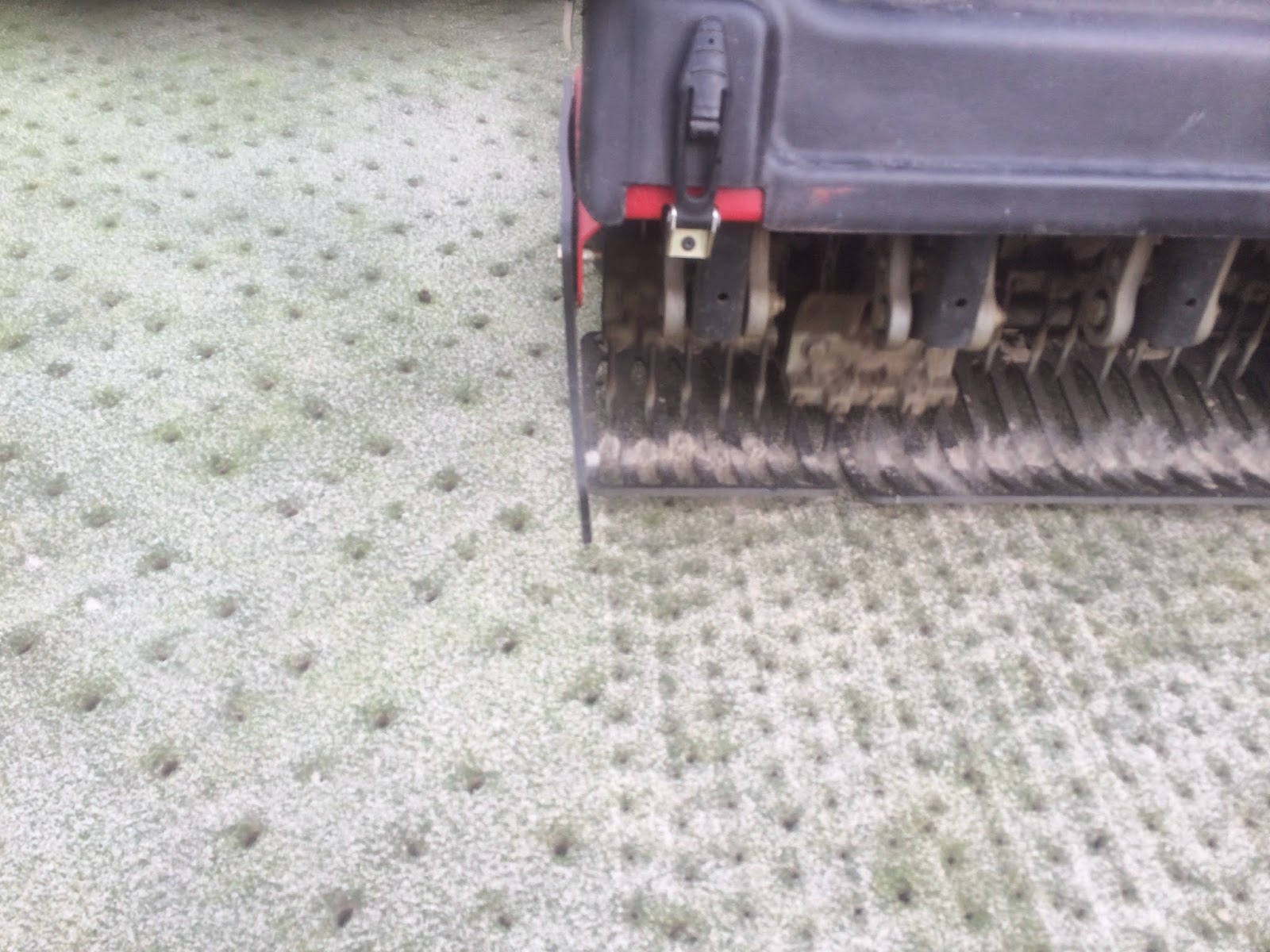
we used 3/8" tines that at 2.0" spacing
this is what the greens looked like behind Pat and the ProCore 648.


I promised the membership we would use tines the size of  a pencil to minimize damage and speed up recovery.  Here is a photo to prove the size of the hole.
 
While that was happening on the greens, two men were bringing in our fwy markers which were then painted by our mechanic when he had some time. 

Fairways begin....

at 7:20am the fairway aerating crew began.  they arrived the day before and were ready to go on schedule.

They had 5 machines working at most times and were able to cover ground quickly

The owner of the company was on sight throughout to keep things rolling.
 
Greens continue...
5 of our groundsmen then blew all the aerated cores into piles 
 
piles of cores, which were half thatch and half sand, were then removed from the greens
 
last green for the day was  #12

Next steps on the greens.....
any hotspots were watered, to avoid problems while dragging sand later.

sand topdressing was then applied at a very heavy rate to fill the holes and cover the putting surfaces
15 green topdressed

topdressing was then dragged into the holes and spread as evenly as possible,  below is a finished look at how the greens appear now.   the two holed plug is a foam insert that we place into the hole in the green to protect it from damage during the process. 


 finishing up the fairways for the day...
over a ton of ryegrass seed was the then broadcasted onto the fairways 

seed was then dragged into the holes while the aeration cores were broken up by dragging an old school tine harrow over them.  unfortunately, with no sun the whole day, the core were never properly dried for the process.

more dragging, and dragging and dragging.


the thatch was then blown into the roughs to hopefully be picked up tomorrow by the sweeper.
panorama view from 10 tee as a lot of work is happening all over.

blowing off 18 fairway.


So ends day one of the process, hope the weather continues to be on our side and praying that when we are done it rains like crazy for a few hours to clean it all up.

thanks for checking in....

see you soon, JohnnyP